












No cup holders, no problem: Driving a 1984 Corvette
No cup holders, no problem: Driving a 1984 Corvette
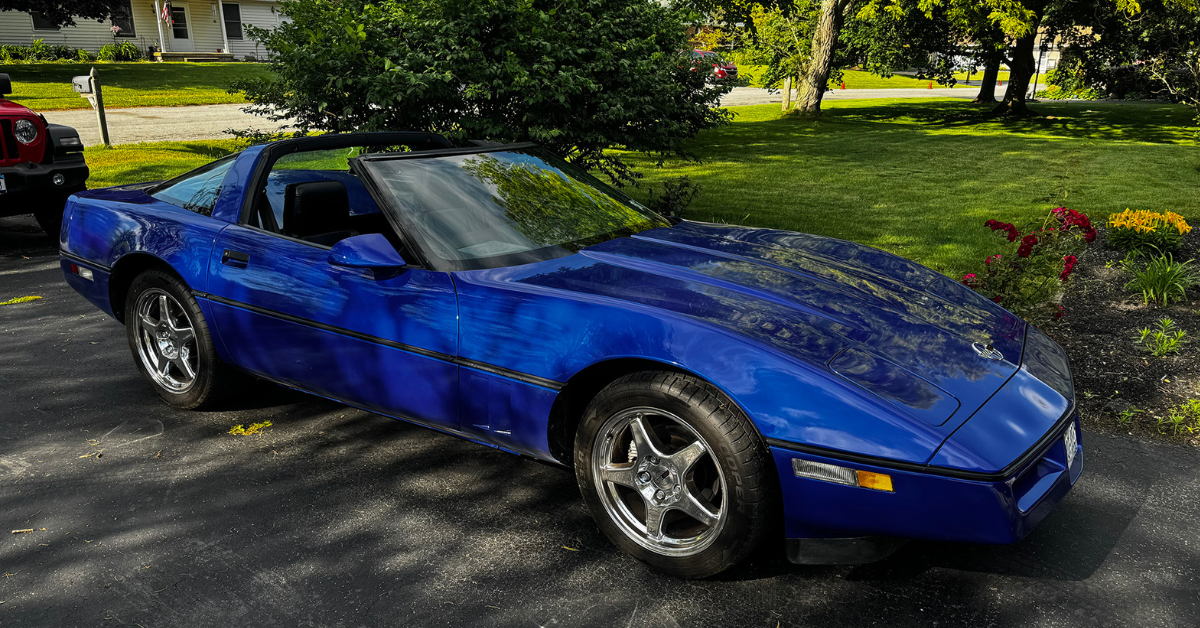
I see a lot of different cars in the parking lot at AAA Western and Central New York's corporate headquarters in Amherst. There's a cheeky Mini Cooper convertible, a sleek Tesla, and a wide variety of black SUVs (my own included). But one recent workday, I was delighted to pull in next to a vivid blue vintage '80s Corvette.
I shouldn't have been surprised to learn that the 1984 Chevrolet Corvette belonged to my colleague, Senior Designer Matt Steinberg. After owning a motorcycle with a sidecar for several years, Steinberg decided to switch it up.
“I wasn't, like, pining for a Corvette,” he said. “I wanted to get another convertible because I missed my Beetle.”
Steinberg looked at Mustangs, Camaros, and Miatas, but nothing quite clicked — until he came across the 1984 Corvette.
"It's a beautiful color, and when I took it for a test drive, I just sort of fell in love with it," he said. "It was just really fun to drive. It's very mechanical because it's 42 years old.”
Driving a car from another era
That “mechanical” feeling is part of what makes driving the Corvette so different from getting behind the wheel of a modern vehicle.
The car has a 350 V8 engine and a carburetor, which means starting it requires pumping the gas. The result?
"It roars to life."
And thanks to its dual exhaust, the Corvette isn't exactly subtle once it's running, either.
"You can really feel the road in it,” Steinberg said. “It’s not like big sedans or SUVs nowadays that have a really soft suspension."
Even the transmission makes its presence known.
"In most modern cars, you really don't feel the shifting," he said. "You feel the shifting in this, especially from first to second. There's a very obvious thump."
But the Corvette also has some surprisingly modern touches for a car built more than four decades ago. There are power windows, cruise control and even a digital dashboard reminiscent of Knight Rider.
Then there are the features that very much belong to 1984.
The original radio has a cassette player. There's an actual cigarette lighter and ashtray, complete with small cutouts designed to hold cigarettes while driving. Steinberg, a nonsmoker, has repurposed that space for spare change.
And there isn't a cup holder in sight.
Some modern conveniences can be retrofitted a little more easily. Steinberg bought an $18 FM transmitter that allows him to stream music from his phone through the Corvette's original radio. He considered replacing the entire head unit, but an upgrade would have cost around $2,500.
“That's the only upgrade I made to it, and that's the only upgrade I'm going to make to it,” he said, “because everything else is vintage and immaculate.”
Of course, that doesn't mean he's completely abandoned 1984. He found a cassette copy of Van Halen's 1984 on eBay specifically to play in the car.
The realities of owning a 42-year-old car
For all its charms, driving a classic car in 2026 comes with a few considerations. For starters, there's fuel.
The Corvette's 350 V8 gets around 22 miles per gallon, which Steinberg considers surprisingly good for an engine that size. The catch is that he fills it with premium gasoline. While the car can technically run on regular unleaded, its previous owner warned him that it doesn't run particularly well on it.
Then there's maintenance.
Steinberg was initially nervous about buying a car more than four decades old, particularly because he isn't someone who spends his weekends under the hood.
"I made sure my normal mechanic who has been working on my cars for 25 years could work on it," he said.
So far, the Corvette hasn't given him much trouble. The original engine has more than 81,000 miles on it, and the only repair he's needed was a replacement turn signal, which his mechanic was able to take care of the same day.
Finding parts for future repairs could eventually prove more difficult.
“I understand that it might be a bit of a challenge to find parts for certain things, but I'll cross that bridge when I come to it,” he said. “That's the thing you've got to be mindful of. You either have to be able to fix things yourself or you have to have a good mechanic."
Steinberg knows which camp he falls into.
“I know a guy who is a tinkerer and I can pay him to fix it,” he said.
That actually helped steer him toward the Corvette. Steinberg had also looked at a 1971 Volkswagen Beetle convertible with a manual transmission, but his mechanic warned that Volkswagen parts could be difficult to find — and that he'd rather not work on it.
"That made the decision easy," Steinberg said.
Insurance was another consideration, although it turned out to be less daunting than Steinberg expected. He insured the Corvette through Hagerty, which specializes in classic and collector vehicles.
"I thought it would cost me a fortune," he said, but he was surprised by how affordable the coverage was.
When and where to drive a classic
The Corvette isn't Steinberg's daily driver. That job belongs to his 2024 Jeep Wrangler.
Instead, the Corvette comes out when the conditions — and the destination — are right.
“It's got to be the right day and going to the right place,” he said.
He drives it to work, where he knows he'll have an easy trip and a safe place to park. But without the hardtop installed, even an ordinary stop at the grocery store requires a little more thought.
The Corvette has no trunk and no glove compartment, and there's nowhere to lock something when the roof is off. If Steinberg stops at the grocery store on his way home, his work laptop comes inside with him.
“Since I don't have the top on it, I've got to be confident that nobody's going to mess with it,” he said.
The roof itself requires some planning, too. Steinberg has an aftermarket soft top that can be installed relatively quickly if it rains, but putting on the car's hardtop is more involved, taking about 15 to 20 minutes and requiring a second person.
The air conditioning doesn't work, either. Steinberg could have it repaired, but in a car he primarily drives on warm days with the roof off, he hasn't found much reason to.
And driving it in a Western New York winter? Absolutely not.
The Corvette will spend the snowy months safely tucked inside his garage. But that doesn't mean Steinberg is one of those convertible owners who waits for a perfect 75-degree afternoon.
“I'm a brave convertible driver,” he said. “Even with my Beetle, if it was 45 in the winter and the sun was out, top goes down. Put on a hat, put on a scarf, and you're good to go. The sunshine makes a giant difference.”
He expects to keep driving the Corvette through the end of October or beginning of November, as long as the weather cooperates.
Some things are worth the inconvenience
There's another part of Corvette ownership Steinberg had to master: getting out of one.
"I had to figure out where to lean my arm and kind of pull myself out," he said. "It's not very elegant and I'm getting better at it. The first couple times I got out of it, it was hard. But now I sort of figured it out."
What he isn't interested in figuring out is the Corvette's top speed. He's taken it to around 80 mph and suspects it has plenty more to give.
"But I'm not a guy who likes to push those sort of things," he said.
He'd rather take it somewhere slower.
"I live in the country, so I'll just find country roads to kind of tool around on,” Steinberg said. "It's nice to drive around the cornfields and farm fields, radio up high, and it's almost like a Zen experience."
For Steinberg, some of the Corvette's appeal comes from the era it represents. He grew up in the 1980s, and the car offers a little connection to that time — digital dashboard, cassette deck and all.
"I've actually got a pair of sunglasses that look like Tom Cruise in Risky Business, so that's what I wear."
But more than anything, the Corvette gave Steinberg something he'd been missing since selling his Beetle: a convertible.
"I think I'll always have a convertible," he said. "Not having one the last couple of years was kind of a drag, so I'm glad I have one now."
It's the kind of enjoyment that's hard to quantify on a list of vehicle specifications.
"I like the wind in my hair, I like the sun on my face. I like being able to smell the road," Steinberg said. "There's something about the smell of new asphalt that makes me think of summer. And I like being exposed to the weather."
The Corvette may require premium gas, a trusted mechanic, and a willingness to live without cup holders. But practicality was never really the point.
"It's not practical for a lot of things, but that's not why you buy it," Steinberg said. "It's just having the expendable income to do something fun."
And Steinberg plans to keep doing exactly that.
"I'll keep it until it's not fun anymore," he said.
Judging by his philosophy on convertibles, that could be a while.
"I think if you can't enjoy convertibles, you can't enjoy fun."
If you're thinking about adding a classic car to your own garage, a AAA Insurance Agent can help you understand your coverage options and find a policy that fits how you plan to use your vehicle.